
When Hamdi Ould Rachid Stole Time from Smara for China
The Blue Door That Opens When It Should Close Forever – A True Story of Desert Wisdom and Modern Compassion
Keywords: Smara tourism, Laayoune Sakia El Hamra, Sahara desert experience, cultural tourism Morocco, authentic Moroccan hospitality, rock art Morocco, tea ceremony tradition, travel guide Morocco, visitsmara.com
The Blue Door
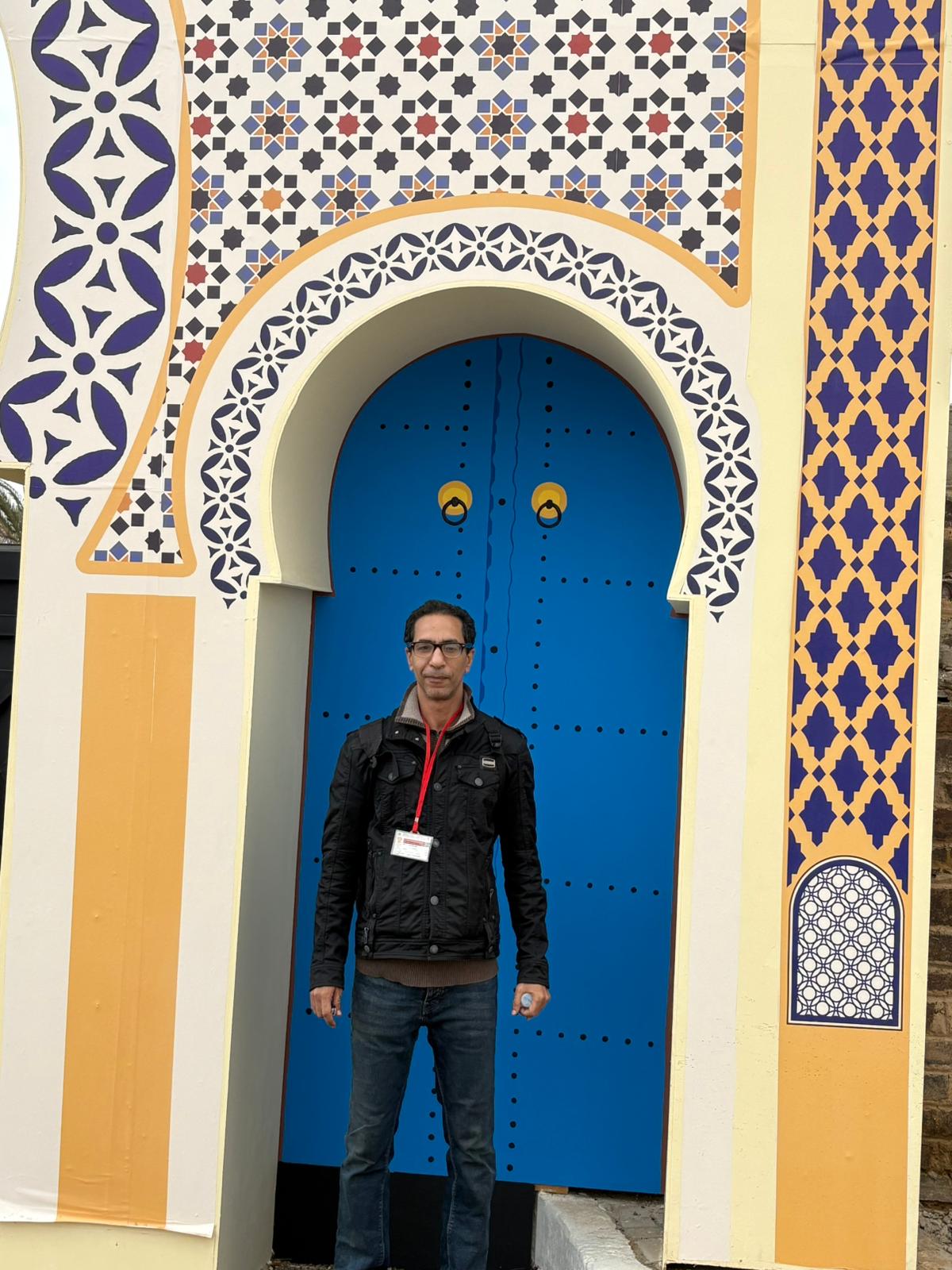
In the heart of Smara stands a modern blue door, adorned with geometric patterns that echo the memory of Andalusia and the spirit of the Sahara. It’s not an ancient door, yet it carries a strange secret: every time I stand before it, I feel as though it crosses a threshold of time, not space.
Here, before this door, Yiyang paused for a moment before leaving the city. We were about to buy souvenirs from the traditional crafts center, his heart heavy with something profound: a mysterious sense that Smara was not merely a passing stop, but a gateway to a new understanding of existence itself. But he didn’t yet know that this blue door would become a metaphor for what would happen to him in just a few hours: a door that would open at the very moment it was supposed to close forever.
1. The Artist Who Never Died
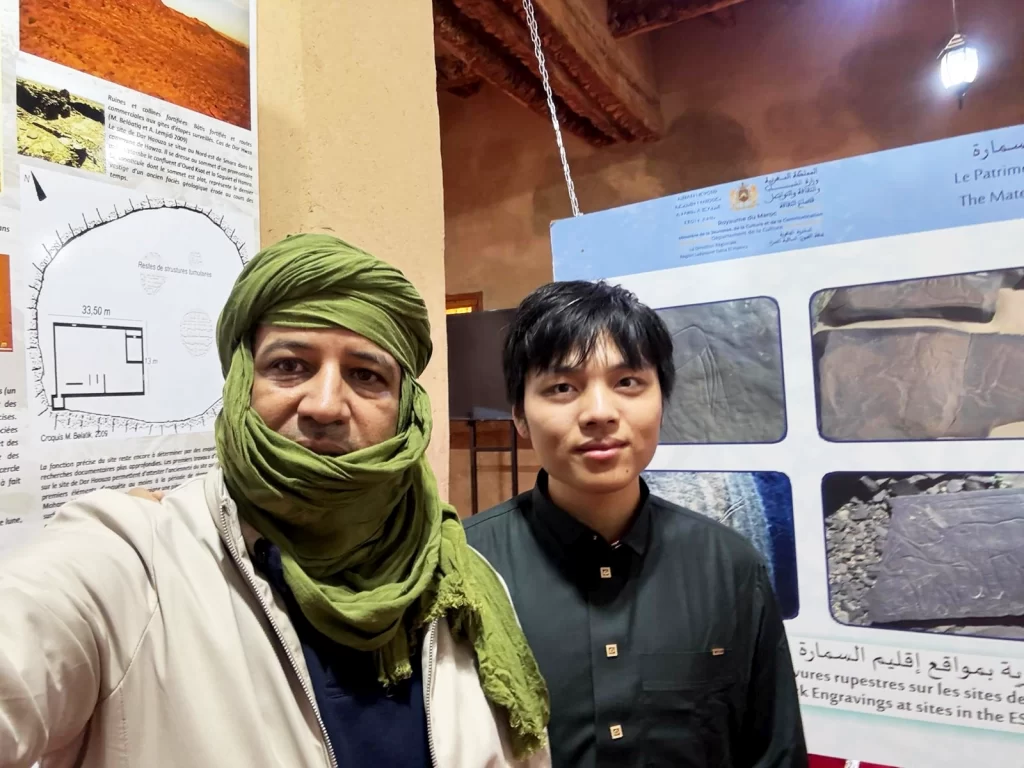
In the early morning, before the city awoke, I led him on a city tour. The sun was still shy, and the air carried the chill of the desert night.
Yiyang stood before a carving of a gazelle. Its lines were simple, primitive, yet charged with a strange presence. He touched the stone slowly, his fingers trembling slightly.
I said in a low voice: “We don’t know this artist’s name, nor exactly when he lived. Perhaps ten thousand years ago, perhaps more.”
Yiyang fell silent, then whispered: “But he never died.”
I looked at him with curiosity.
Yiyang continued: “I mean… we’re standing here now, touching what he touched, seeing what he saw. He’s biologically dead, but alive in this stone. Death isn’t the end of the body, but the end of impact. And this man… his impact is still alive.”
I smiled deeply, like someone watching a student grasp a difficult lesson for the first time.
“The desert, Yiyang, is not an empty place. It’s carved memory. Every stone here is a witness. Every dune here is an archive. We don’t walk on sand, but on accumulated layers of time.”
In that moment, Yiyang realized something magnificent: that civilization is not what we build in towers, but what we leave as traces in the soul of place. China built its Great Wall, but this unknown artist built something greater: he built a bridge between past and present, between death and immortality.
2. Tea Poured from Height
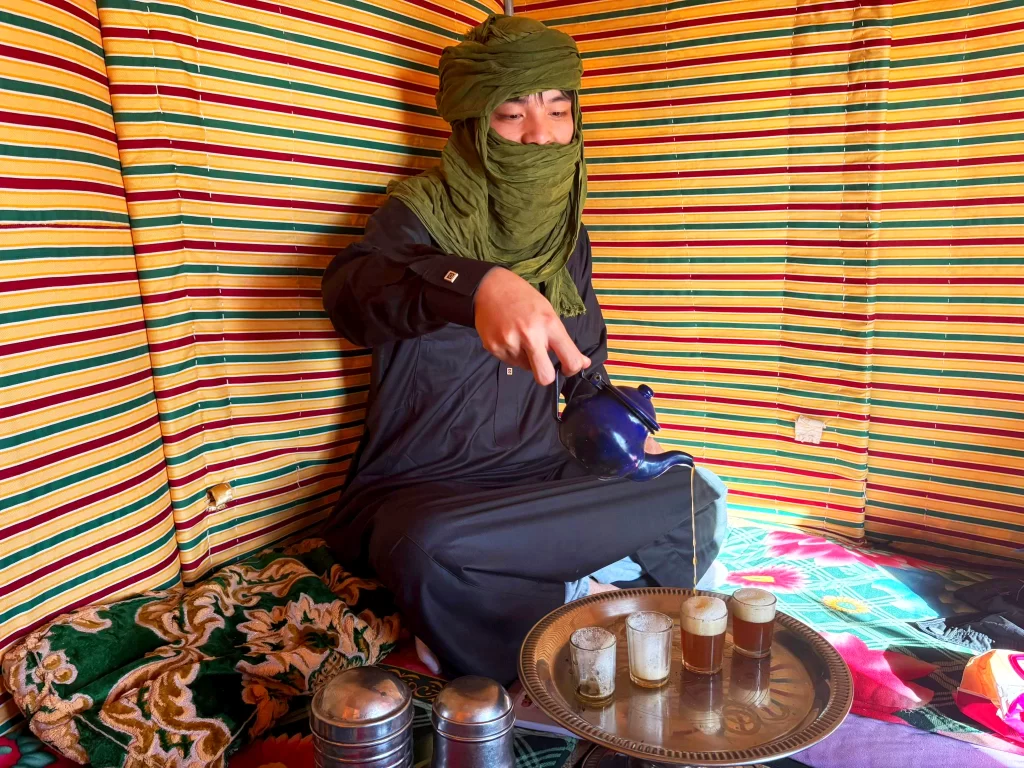
In Wad Salwan, Yiyang sat in a worn tent. The sparrows moved with measured slowness, and the sun poured its fire onto the acacia trees. No noise, no haste, no worry.
My companion poured him a glass of tea from a height. The golden liquid fell in a long arc, like a small waterfall of liquid time.
Yiyang asked: “Why do you pour it from such a height?”
My companion answered with an enigmatic smile: “To give the air a chance to taste it before us.”
Yiyang’s mouth opened to reply, but he closed it. The answer wasn’t logical, yet it was somehow correct.
My companion continued: “Tea is not just a drink, our guest. It’s a ritual. And ritual is what distinguishes humans from animals. An animal drinks to quench thirst. But humans drink to create a moment.”
Yiyang took a slow sip. The tea was bitter and sweet at once, complex as life itself.
My companion said: “In China, you drink tea in silence, as meditation. And that’s beautiful. We drink it with conversation, as celebration. Two different ways to the same truth: that tea is a way to slow down time.”
Then he brought him a plate of hot grilled meat. The fat melted slowly over pieces of liver, and the aroma of warmth, home, and longing filled the air.
My companion said: “This food is simple, but loaded with time. The time of shepherds who tended sheep, the time of women who kneaded dough, the time of fire that cooked it slowly. Every bite is a geological layer of human history.”
In that moment, Yiyang understood that civilization is not measured by the speed of its production, but by the depth of its rituals. And that slow food is resistance against fast time.
3. The Nightmare
Then came the moment when everything turned into a nightmare.
Yiyang stood before the traditional crafts center, choosing gifts for his friends in Newcastle: a small leather pouch, a box of tea, a brass lantern. He was fascinated by the details, immersed in the moment, as if time had stopped.
Then he looked at his watch.
Eight o’clock in the evening.
He froze.
His flight from Laayoune was taking off at ten-thirty. And the road would take at least two and a half hours.
He felt the blood freeze in his veins. Not only because he would miss the plane, but because everything would collapse: the non-changeable ticket, the exam scheduled in two days, the visa that would expire, the entire future hanging on a thin thread called “departure time.”
I called the driver. They ran to the car. They set off at maximum speed.
The road was straight, endless, cruel. And the sun was setting with mocking slowness, as if enjoying his torment.
The kilometers passed heavy as stones. Every minute was a year, and every year was agony.
They arrived at Laayoune airport at ten-ten.
Yiyang rushed toward the boarding gate, his heart pounding like a war drum, his body trembling from exhaustion and fear.
But the employee stopped him with an outstretched hand, firm as the judgment of fate:
“Sorry, sir. The gate is closed.”
4. When the Closed Door Opens
In that moment, Yiyang felt something strange and terrifying at once: he felt that modern civilization, with all its atomic clocks and precise schedules and tight systems, was actually more cruel than the desert.
The desert grants time. But civilization steals it.
The desert says: “Take your time.” But civilization says: “You’re ten minutes late, and that’s enough to destroy your life.”
He stood stunned, helpless, defeated. Everything he built, everything he planned, everything he dreamed of, now collapsing before his eyes because of ten minutes.
Then, as if the desert had summoned one of its wise men, a man appeared.
He didn’t appear like a hero in a Hollywood film, but like a natural phenomenon. His presence carried the same weight that sand dunes carry: something undeniable, existing since time immemorial, imposing itself quietly.
It was Hamdi Ould Rachid, President of the Laayoune-Sakia El Hamra region.
As if he knew that this kind of rare curiosity deserves to be rewarded, not punished.
He approached Yiyang calmly and placed his hand on his shoulder. It wasn’t a casual touch, but one loaded with something deeper: with protection, with generosity, with belonging.
He said in a calm voice, but one that carried the authority of the entire desert:
“The desert doesn’t abandon its guests.”
Then he turned to the employee. He said nothing. He didn’t raise his voice. He didn’t issue an order. He just looked at her.
But that look said everything: that there are laws higher than flight schedules. That generosity is older than bureaucracy. That the human being is more precious than the clock.
The employee hesitated for a moment, looked at the clock, then at Hamdi, then at Yiyang.
Then, as if an invisible blue door had opened in the air, she said:
“Please proceed, sir. But run.”
5. The Lesson
Yiyang ran toward the plane as if running toward life itself. He climbed the stairs, his heart about to explode.
Before entering, he turned to look at Hamdi, who stood in the distance, waving with a smile as warm as sunrise over the dunes.
Yiyang shouted in a hoarse voice: “Thank you! Thank you, sir!”
Hamdi answered in a voice carried by the air: “Come back again, my son. And next time, give Smara more than one day. The desert deserves longer time.”
6. What Was Written on the Plane
Yiyang sat in his seat, the plane cutting through the clouds. His hands were trembling, not from fear, but from something else: from realization.
He opened his notebook and wrote, tears trying to betray his eyes:
“China built its Great Wall to protect its civilization from barbarians. But who protects civilization from itself? Who protects it from turning into a cold machine that measures humans by minutes and seconds?
In Smara and Laayoune, there was no wall. But there was something greater: men who know that time is not a master, but a servant. Men who know that true civilization is not measured by its ability to build towers, but by its ability to stop time for one person, a stranger, lost.
Today, time stole a whole day from me. But a man named Hamdi Ould Rachid gave it back to me. No, he didn’t give it back. He taught me that time was never mine in the first place. Time belongs to the moment we live. Belongs to the person we meet. Belongs to the desert that whispers: slow down, you are not a machine.
In Smara, I didn’t learn history. I learned that history is not what passed, but what we carry in every step. And that the greatest civilizations are those that know that the human is more precious than the clock, and that the moment is more lasting than the empire.”
7. The Blue Door Never Closes
This morning, as Yiyang was minutes away from his city, I hung a picture of a blue door in Smara in my office.
My friend (a son of Smara) asked me: “What’s the story of this door, Said?”
I smiled and said: “This is not a door. This is a metaphor.”
“A metaphor for what?”
“For the idea that closed doors can be opened, if there is someone who believes that the human is more important than the law, and that generosity is stronger than the system.”
Yiyang tells them the story. The story of one day in Smara. The story of a man named Hamdi Ould Rachid, who stole time from the mouth of modern civilization and gave it back to a lost Chinese young man.
And he always concludes with the same question, leaving it hanging in the air:
“What is the greater civilization: the one that builds the tallest towers, or the one that knows when to stop time?”
The Impact That Never Dies
Today, somewhere in Smara, stands a modern blue door. Not ancient, but carrying memory.
And somewhere in Beijing, a student teaches his colleagues that civilization is not what we build, but what we leave in the souls of others.
And somewhere between Smara and Beijing, time continues to turn, but it stops sometimes, for one moment, for one person, for one lesson:
That the artist who drew the gazelle ten thousand years ago never died.
And that Hamdi Ould Rachid, who opened a door in an impossible moment, will never die either.
Because the true impact is not what we build from stones, but what we plant in hearts.
And thus, in one moment before an airport gate, Hamdi Ould Rachid stole Smara’s time for China.
Or perhaps, he restored to time its true meaning: to be in service of humanity, not a master over it.
GET IN TOUCH
Experience the timeless wisdom of the Sahara with expert guide Said Legbouri.
From ancient rock art to traditional tea ceremonies, discover a side of
Morocco that few travelers ever see.
Experience authentic Sahara hospitality with expert guide Said Legbouri
Discover Smara’s ancient rock art, traditional tea ceremonies, and timeless wisdom
Visit www.visitsmara.com for unforgettable journeys where time serves the traveler
Said Legbouri – Your Gateway to Smara’s Soul